
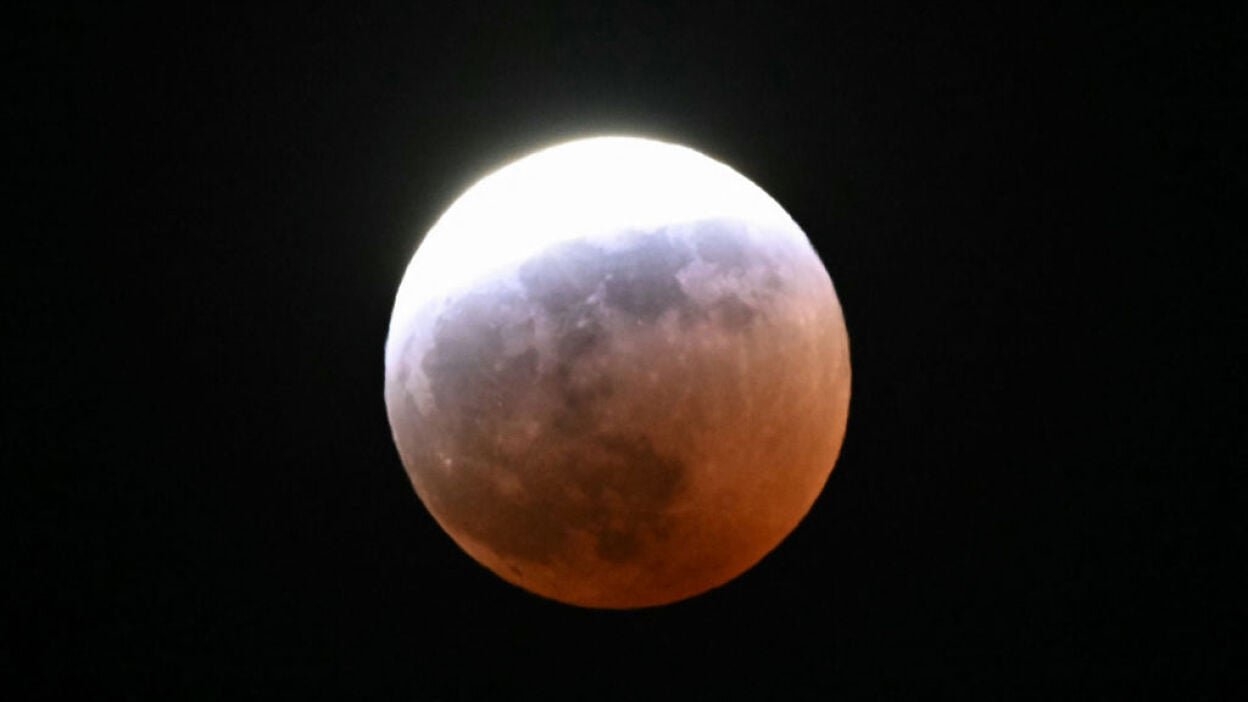
Residents in North and South America, as well as some areas in Europe and Africa, will witness a partial lunar eclipse on August 27, where the moon will appear reddish, resembling a heated fireplace poker.
You can observe this lunar event without special darkened glasses, unlike solar eclipses. This presents a rare opportunity to witness a significant lunar phenomenon before the next total lunar eclipse in 2029 for much of the Americas.
Several telescope observatories will offer free livestreams for those living in areas with constant city light pollution or cloudy weather.
During a lunar eclipse, the Earth moves between the sun and the moon, creating a large shadow on the moon’s surface. This upcoming occurrence is particularly exciting as it will be a significant partial eclipse.
Earth’s shadow will cover more than 96 percent of the moon’s surface at its peak, causing the moon to shine in shades of coppery orange and red due to the filtered sunlight from Earth’s atmosphere.

NASA states that it seems like the Moon reflects all the sunrises and sunsets from around the world.
If you choose to go outside, bring binoculars to observe Earth’s curved shadow moving over lunar craters. You may see additional stars appearing in the darkening night sky due to the decreased moonlight brightness. A standard smartphone can capture a memorable photo.
- NASA decides to give up on a space telescope rescue mission despite its reluctance.
- The center of the Milky Way contains the remains of a different old galaxy.
- The top telescopes for observing stars and solar eclipses in 2024
- The Webb telescope is getting a solution to avoid being blinded by bright planets.
- NASA reported that the SpaceX rocket crash created a crater on the moon the size of a basketball court.
If you live outside the eclipse viewing area or wish to observe with professional equipment, various astronomy organizations offer free live broadcasts on the night of Aug. 27 and early morning of Aug. 28, depending on your location.
- Griffith Observatory will start its live stream from Los Angeles at 10:25 p.m. ET / 7:25 p.m. PT on August 27th.
- Watch the moon illuminate Tuscany through the high-resolution telescope views provided by The Virtual Telescope Project starting at 9:30 p.m. ET / 6:30 p.m. PT on August 27.
- Watch a live telescope broadcast with interactive animations and commentary by experts on August 27 at 10 p.m. ET / 7 p.m. PT on Timeanddate.com.
The Griffith Observatory begins its livestream from Los Angeles at 10:25 p.m. ET / 7:25 p.m. PT on August 27th.
Watch the moon shining over Tuscany with high-quality telescope views starting at 9:30 p.m. ET / 6:30 p.m. PT on August 27 through The Virtual Telescope Project.
Watch a live telescope broadcast with interactive tracking visuals and commentary beginning at 10 p.m. ET / 7 p.m. PT on August 27th on Timeanddate.com.
The primary event extends for more than an hour, allowing ample time to switch between streams and appreciate various telescope perspectives.

Elisha Sauers, a writer for Mashable, delves into NASA’s missions to the moon and Mars, interviews astronauts and groundbreaking discoverers, and travels above the clouds. With 17 years of experience in journalism, she has covered various topics such as health, business, and government, with a particular interest in public records requests. Sauers has received multiple state awards, including the Virginia Press Association’s prestigious Best in Show award, and has been nationally recognized for her narrative storytelling. She has consistently won National Headliner Awards for her space coverage, including first place for her Sex in Space series. To share space tips or story ideas, contact her at [email protected] or text 443-684-2489. Follow her on X at @elishasauers.